Share
Showing posts with label Saturday. Show all posts

Saturday, September 8, 2012

Saturday Random Day - South Korea 1 Won


South Korea
1 Won - 1962 (ND)
UNC - Pick #30
Catalog Value: $1.00

 So here's something that I bought a while back for about 25 cents.  I've always found these notes to be interesting and in a personal sense; collectible.  The 1962 series of South Korean notes were the first to bear the "Won" denomination, 100 Jeon = 1 Won.  The predecessor notes used to bear the "Hwan" denomination.  From an English point of view, Hwan and Won sound very similar and people may make the mistake that they are the same thing, they are phonetically the same but in Korean, "Hwan" or "圜"was always written in Hanja (Traditional Chinese Characters) while "Won"or "원" is always written using the Korean alphabet.  I have a few notes that bear the former "Hwan" denomination, those came mainly from my Grandparents who kept a few notes before they left South Korea and immigrated to the U.S. 

I have about 4 of these 1 Won notes that were actually used in daily commercial transactions.  Although my mother was about 10 years old when these were first issued, I'm not sure if she ever saw or used one when she lived in Korea.  That's really the only reason why I bought this, it's a little piece of history from the time when my mother was a child.  As such, I still buy as much Korean currency as possible (as long as the price tag is reasonable).

Unfortunately, 1 won in current monetary terms is worth close to 1/10th of a cent.  I'm pretty sure that the buying power of this note was considerably more back in 1962, but in today's terms, 1 won really isn't worth anything.  Enjoy!

Saturday, August 25, 2012

Saturday Random Day - Vive La France!

C'est pour mes amis francophonie, et aussi pour mes amis Français qui viens de Lyon (Allez Olympique Lyonnais!) et les autres villes Français.  Je suis désolé pour mon mauvais français, mais j'ai oublié la plupart de la langue.  J'ai pensé qu'il serait amusant de post en français pour la première fois sur mon blog.  L'histoire: j'ai acheté ces pièces dans un magasin à Michigan (E.U.) pour à peu près 0,50 Euro.  C'est pas cher aux états-unis et il y a une grande variété de pièces à choisir.  C'étaient les meilleures pièces françaises que j'ai pu trouver.  Il devient de plus en plus rare de trouver pièces françaises ici.  C'est fatigant (écrit en français)! Fin!

Back to Anglais, I found these at the coin store in Michigan, part of that large hoard that I pulled out.  The 25 centimes coins were about the most valuable in here and they are quite old! I did this post in French because I can speak it (to an extent).  And now that I'm really tired, I'm going to leave you with the stats!


France
5 Centimes – 1901
VF – KM#842

France
5 Centimes – 1912
VF – KM#842

France
5 Centimes – 1931
XF – KM#875

France
10 Centimes – 1918
XF – KM#866a
France
25 Centimes – 1903
VF – KM#855

France
25 Centimes – 1904
VF – KM#856

France
50 Centimes – 1923
VF – KM#884

France
1 Franc – 1921
XF – KM#876
France
10 Francs – 1947
XF – KM#909.1

France
10 Francs – 1948
CF – KM#909.1

France
100 Francs – 1954
XF – KM#919.1

France
1 Franc – 1992
XF – KM#1004.1

Saturday, August 11, 2012

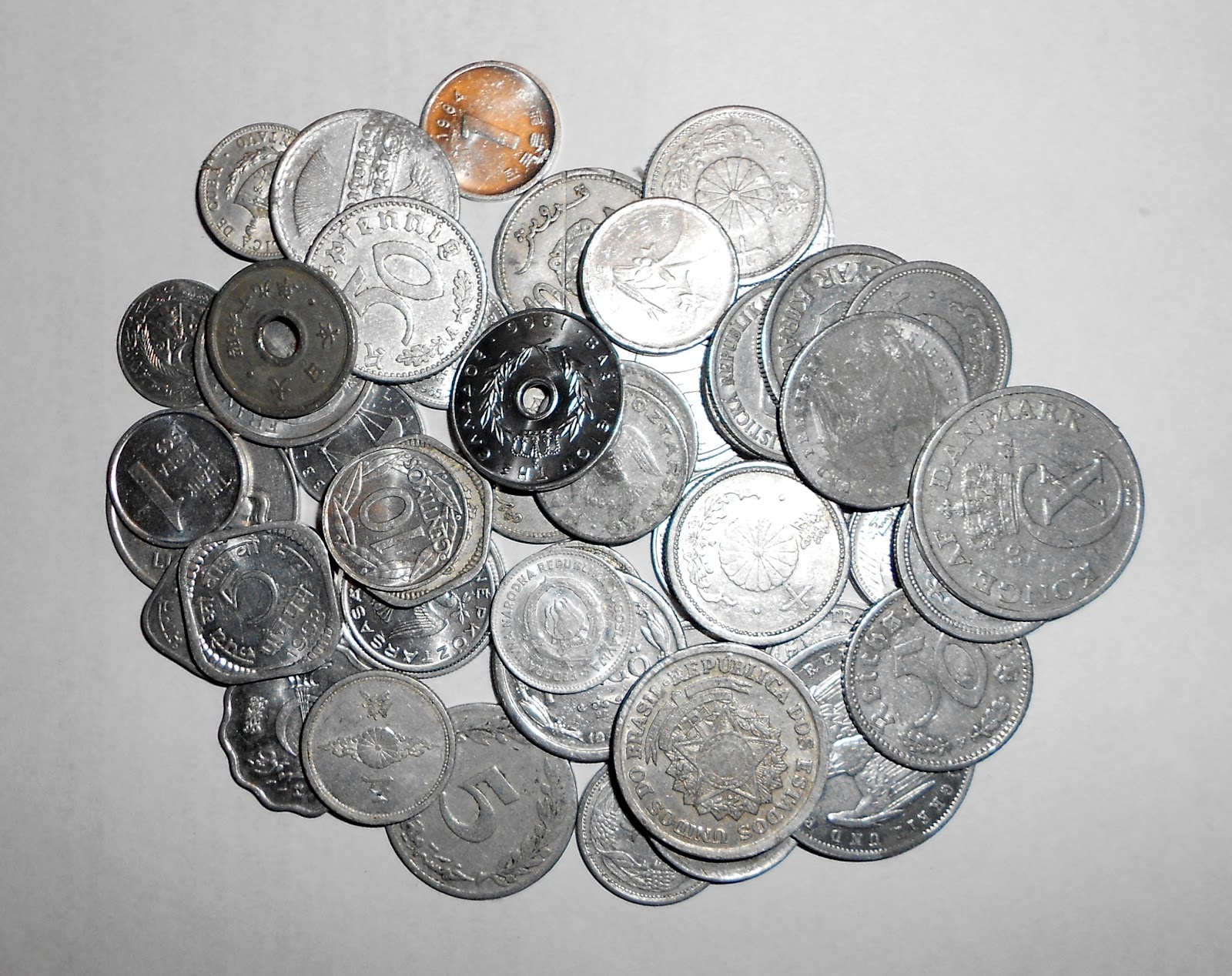
Saturday Random Day - Cherry Picking Dealer Coin Dumps; Zinc & Aluminum Coins

 42 Cherry Picked Zinc Coins: Value About $80.00
53 Cherry Picked Aluminum Coins: Value About $30.00

 Cherry picking is an art; you have to know what to look for and have a keen eye for odd-ball coins.  Coin dealers across the US and Canada almost always have a foreign coin dump bin where the sell various coins for 10-50 cents a piece.  If you enjoy finding something for almost nothing, cherry picking dealer dump bins are almost always a sure-shot for finding something valuable.  The reason is that the majority of coin dealers will buy estate lots, coins from people who don't collect coins and the like, but they purchase them at a huge discount.  Usually these large lots will contain a good amount of foreign coins that the dealer has no idea what to do with, so they end up in the dump bin.  Granted, the dealer will always do a cursory inspection for gold, silver and rare coins, the rest of the coins are almost not worth dealing with, so they end up in a coin bin.  Although the price on the bin usually says "1 for 25 cents or 10 for $2.00", the dealer is almost always willing to make a deal to have those coins taken off his hands.  Whenever I walk into a coin store and see the bin, I ignore the stated price completely and simply ask the owner if I could purchase coins by the pound and they usually oblige.  The last place I went to let me pick out all the coins I wanted for $5.00/lb.  That's a steal for anyone who's looking for a good deal, it's also beneficial for the dealer, so it's a win-win situation.  Online sites will usually charge $8-20/lb + shipping which is a complete rip-off as you don't even know what you're getting.  Always go to a physical store if you have one nearby.

If the dealer offers a reasonable price for foreign coin poundage, say $1-8/lb, the first coins I go after are the zinc and aluminum coins.  First off, these coins are almost always over-looked.  For aluminum coins, people think that since the coin was made from aluminum, the coin is cheap, low denomination and mass produced.  Although those assumptions are somewhat accurate, older aluminum coins can fetch a pretty penny! I got lucky this time around and found a WWI Emergency Token from Perpignan, France (posted earlier) and it was worth a lot more than what I paid.  With zinc coins, the same can also be said with the additional assumption that the average collector will assume that the coin is dirty instead of coming to the conclusion that the coin is made from zinc and the coin is actually oxidized and not dirty at all.  Zinc coins will fetch a higher price than aluminum coins, so if I had the choice, I would just hoard all the zinc coins that I could find before I started going after the aluminum.   Zinc coins are almost always old, they were most frequently produced during WWI and WWII as a substitute metal for copper and nickel which were unfortunately used to produce war machinery and ammunition, instead of making beautiful, peaceful coins!  When you find a zinc coin, the patina is always very distinctive; dark and dull.  That darkness and dullness is a result of the zinc reacting with the elements and oxidizing.  This oxidation actually creates a protective layer on the coin, much like copper.  I pulled quite a few zinc coins this time around and found some great numismatic pieces.  I only paid 4 cents a coin and came out with around $200.00 worth in total from the 442 coins the I bought; not a bad investment.  

If any of you have any questions/comments pertaining to anything about coins, paper money or collecting in general, feel free to contact me or comment, I'm more than willing to give you my 2 cents! Happy Saturday!


Saturday, July 14, 2012

Saturday Random Day - Thailand


So I'm already breaking my own rules to blogging, but guess what, I was going to post this yesterday, but decided not to.  Regardless, what you see here are the newest additions to my collection and the latest update to Thai coinage.  Granted, the new obverse images were released in 2008 and 2009, they are still new to Thai people and you won't find too too many in circulation.  These gems were given to me by my fiancees mother, not father! She too knows about my passion and love for coins, and so, she sent the maid out to go get some pocket change and buy some stuff, and as a result, I ended up with around 300 Baht worth of Thai coins. I plucked out the older ones and only wanted to show you guys the new face of Thai coinage.

The Facts:
Thai 10 Baht coins: The ones pictured above (bi-metallic) are dated B.E. 2553, 2554, 2555 (2010, 2011, 2012 respectively).  The composition of these coins have not changed from the previous version, the only thing that is different is the obverse.  I actually have a mint-sealed bag of these coins from 2009 with both the new and former obverse images (100 per bag at 1000 Baht for the entire bag).  I'm going to hang on the bag (as I always do) as I believe that one day, it will be worth some money because of how unusual it is to have a bag containing 2 different versions of the same coin.

Thai 5 Baht coins: Pictured to the right of the 10 baht ones, dated B.E. 2551, 2552, 2554, 2555 (2008, 2009, 2011, 2012 respectively).  The metal composition of these coins have not changed BUT, the weight of the coin has.  They reduced the amount of copper and nickel in the coin to save costs which in-turn, made the coin slimmer.  Both the obverse and reverse of the coin has been changed slightly from its predecessor.  Still a great coin!

Thai 2 Baht coins: Pictured below the 10 baht coins, dated B.E. 2553, 2554, 2555 (2010, 2011, 2012 respectively).  These coins are my second favorite Thai coins.  Reason being is that they are highly unpopular in Thailand and when I lived there the first time, they didn't even exist.  When the first 2 Baht coin was released for general circulation, it was made from nickel plated steel.  The coin was similar is size and color to the 1 Baht coins, which for vendors, made them somewhat confused.  When you do find the original 2 Baht coins, you will usually see a "2" written on the back of the coin in permanent marker.  Now the reason that the coin was only written on the reverse of the coin is due to lese majeste laws in Thailand which makes it illegal to deface currency, especially when defacing currency means drawing on the face of the King; highly disrespectful and in extreme cases, could land you in jail!

Since the coins were so unpopular and vendors kept drawing the number "2" on the reverse of them, the Royal Thai Mint was forced to make a different 2 Baht coin, which are the ones represented above, made from brass.  The reason that the RTM did not want to withdraw the entire issue was due to cost-saving concerns of minting less 1 and 5 Baht coins and using 2 Baht coins to fill the void.  So basically what you see above is a modern failure of a coin, which to me, makes it a very collectible coin! I currently have 300 of the original 2 baht coins that were only minted for 2 years and about 500 of the newer ones.  Yeah, I tend to hoard coins, can't help it!

Thai 1 Baht coins:  Pictured below the 5 Baht coins, dated B.E. 2552, 2553, 2554, 2555 ( 2009, 2010, 2011, 2012 respectively). These coins are different from their predecessors in terms of metal content.  They are made from nickel plated steel unlike the former coins, maybe a trade-off for their failure to get the original 2 Baht coin into circulation.  Many of these 1 Baht coins seem to be struck weakly, but unlike the former 1 Baht coins, they don't tend to tarnish as fast as they used to! I have plenty of these, numbering in the 1000's, from all years of production.  Since I have so many of them, I'm going to have to sort out the dates and find the best specimens to put into a display album one day; likely a daunting task!

Thai 50 Satang coins:  Pictured at the very bottom to the left, dated B.E. 2551, 2553, 2552 (2008, 2010, 2009 respectively).  Like the 1 baht coins, the metal contents of these have also changed.  They are made from copper plated steel (I believe) unlike the former 50 Satang coin which looked golden in color, these tend to tarnish VERY quickly once fingers get on them.  If you were a tourist in Thailand, you would likely never run into these coins, along with the 25 Satang coin.  Like the U.S. penny, people generally don't use these coins.  If you wanted to pick some up, you would need to go to a grocery store, like Villa Supermarket, or the grocery stores at Siam Paragon or Emporium.  When my family and I lived in Thailand, we used to go out on Christmas eve and give out the loads upon loads of these 50 and 25 satang coins to the beggars, along with food, clothing, a blanket and about $10 cash.  When I see these coins, it always gives me a sense of nostalgia, and gives me a good feeling that we tried to help some people in desperate need.  It was a way for my mother to give back to the people and the country that temporarily adopted her and made her life extremely fun and enjoyable.  The next time I go back, I think I will follow in her footsteps and give back to the Thai people, maybe donate some of my time at an orphanage, donate some money to a charity or feed the monks.  Thailand to me is a heavenly place!

Thai 25 Satang coins: Pictured at the very bottom to the right, dated B.E. 2551, 2553, 2554 (2008, 2010, 2011 respectively).  Not to make the story short of anything, but basically what can be said of these coins would be exactly the same as the 50 Satang coins.  The metal contents have changed from the former coin to a copper plated steel coin.  What's interesting is that they are worth slightly less than 1 U.S. cent. If you ever have a chance to go to the Royal Thai Mint (which is a one day adventure to a part of Bangkok that is not on the typical tourist map) I would highly advise doing so.  When I went there, I picked up about $50 worth of Thai coins, and relating to this coin, I picked up 2 bags of these 25 Satang coins, which contain 400 coins per bag for 100 Baht (3.33 US$).  You get a lot of coins for a few bucks, but not only that, almost no one abroad has a bag of these gems, so you get that rarity aspect too!

Enjoy!